Importing from China: How to Manage Stock When Your Lead Time Is 190 Days
By Canopy Team
Quick answer
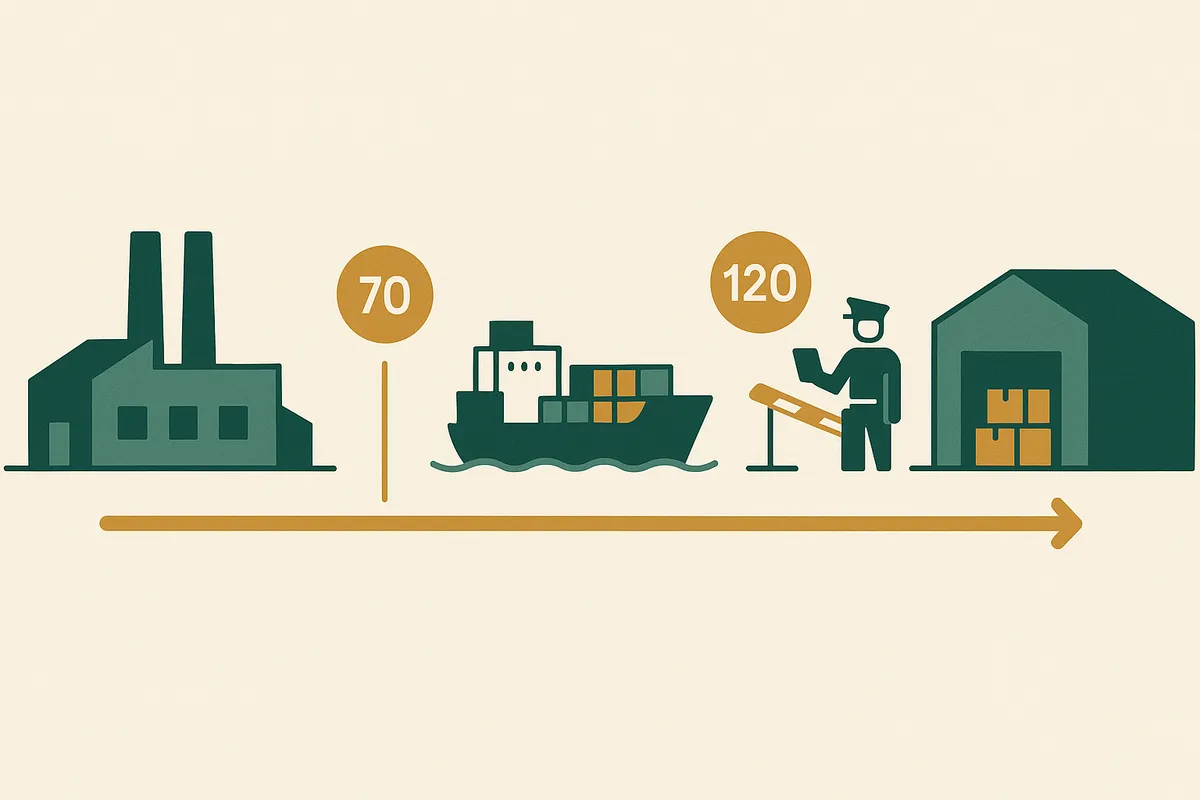
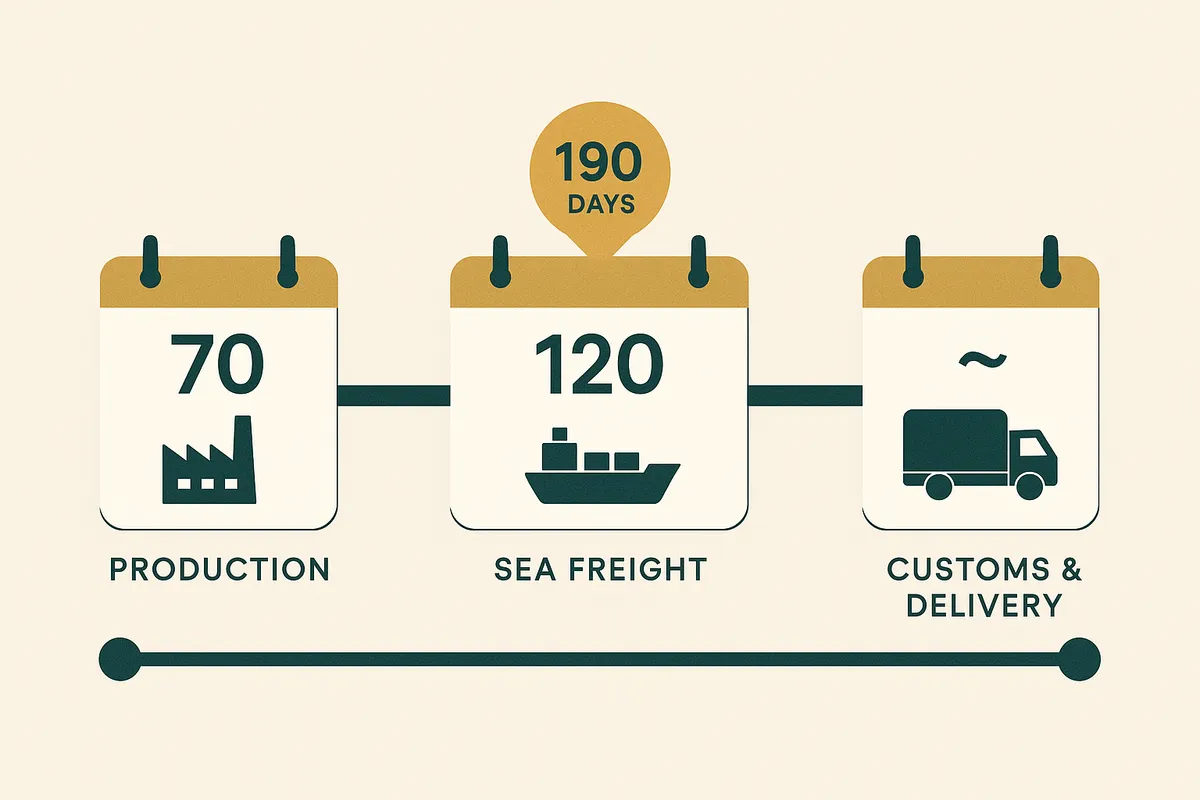
Importing from China means accepting a total lead time of 150-200 days from placing an order to having stock on your UK warehouse shelf. For most products, that's 60-90 days production, 30-45 days sea freight, and 7-14 days customs clearance and UK delivery. This means every purchasing decision you make today is a bet on what will sell 6 months from now. The brands that get this right use rolling demand forecasts, fixed ordering calendars, minimum order quantity (MOQ) strategies, and — critically — they verify every packing list before shipment. The ones that get it wrong end up with either stockouts during peak season or containers full of dead stock.
Understanding the 190-day lead time
Let's break down exactly where those 190 days go, using Bailey & Coco's actual timeline for a dog harness order placed with their Guangdong supplier.
Day 0: Purchase order placed Order confirmed with supplier. 50% deposit paid via T/T (telegraphic transfer). Order: 500 units across 12 pattern variants.
Days 1-7: Material sourcing Supplier orders fabric, buckles, D-rings, and packaging materials. Some materials are in stock, others need to be ordered from sub-suppliers.
Days 7-14: Pre-production sample Supplier produces 1-2 samples of new patterns for approval. Existing patterns skip this step. This is where delays creep in — if you reject a sample, add 7-10 days per revision.
Days 14-70: Production Bulk production for the full order. Bailey & Coco's supplier runs a batch production line — all 500 units are cut, sewn, assembled, and QC'd in sequence. Production capacity is shared with other clients, so peak season (September-November, when everyone orders for Q1) means longer queues.
Days 70-75: Packing and loading Finished goods are packed into cartons, palletised, and trucked to Shenzhen port. Final balance payment due before shipping documents are released.
Days 75-80: Port handling and vessel loading Containers are loaded onto the vessel. Booking a slot on a vessel can add 5-10 days if demand is high.
Days 80-120: Sea freight Shenzhen to Felixstowe is approximately 30-35 sailing days via the Suez Canal. Add 5-10 days for transhipment delays, port congestion, or weather.
Days 120-125: UK port handling and customs Container arrives at Felixstowe. Customs clearance takes 1-3 days if paperwork is in order. HMRC may select your container for physical inspection, which adds 3-7 days.
Days 125-130: UK haulage Container delivered from port to warehouse by road haulage. Typical 2-5 day booking lead time.
Days 130-140: Goods receipt and put-away Unload, count, verify against packing list, barcode scan, and shelve. For 500 units across 12 variants, this takes a full day.
Total: approximately 140-190 days depending on the specific order
This means if you place a purchase order on 1st January, you're receiving stock between mid-May and early July. If you need stock for Black Friday (late November), you needed to order it in May or June.
The ordering calendar: when to place each purchase order
With a 190-day lead time, you can't react to demand — you have to predict it 6 months in advance. The solution is a fixed ordering calendar that aligns purchase orders with selling seasons.
Bailey & Coco places 4 major orders per year:
January order (arrives June-July) Covers summer selling season (July-September). Lower volume — summer is their quieter period. Focus on lightweight accessories, bandanas, and seasonal patterns.
April order (arrives September-October) The critical order. Covers the Q4 peak season (October-December) including Black Friday, Christmas, and the January sales tail. This is their largest order by volume — typically 40% of annual purchasing.
July order (arrives December-January) Covers Q1 (January-March). Replenishment of core lines that sold through in Q4, plus new spring patterns.
October order (arrives March-April) Covers Q2 (April-June). Spring and summer transition stock.
The January order is particularly high-risk because it requires predicting Q4 demand 10 months in advance. Bailey & Coco uses a combination of prior year Q4 sales data (adjusted for growth rate), pre-order signals from wholesale accounts, and trend analysis on new patterns.
The key discipline: orders are placed on schedule regardless of how busy the team is. Missing an ordering window by even 2 weeks can mean stock arriving too late for the selling season it was intended for.
MOQ management: making minimum order quantities work
Most Chinese manufacturers impose minimum order quantities (MOQs) per SKU per production run. Bailey & Coco's supplier requires 50 pieces minimum per pattern variant.
With 152 patterns, ordering 50 of everything would mean 7,600 units per order — whether or not demand justifies that volume. This is where MOQ management becomes critical.
Strategy 1: Tiered ordering Not every pattern gets ordered every cycle. Bailey & Coco categorises patterns into three tiers: - Tier 1 (core, evergreen patterns — 30 patterns): Ordered every cycle, quantity based on demand forecast - Tier 2 (seasonal best-sellers — 50 patterns): Ordered twice per year, aligned with their selling season - Tier 3 (niche/new patterns — 72 patterns): Ordered once per year or on-demand when stock depletes
Strategy 2: MOQ negotiation After 3 years of consistent ordering, Bailey & Coco negotiated MOQ reductions on Tier 1 patterns to 30 pieces. This freed up cash to test more Tier 3 patterns at lower risk.
Strategy 3: Consolidated production runs The supplier batches multiple product types (collars, harnesses, leads) that use the same fabric pattern into a single production run. This means the MOQ is met across product types rather than per individual SKU — 20 collars + 20 harnesses + 10 leads = 50 pieces in the pattern.
Strategy 4: Drop underperformers ruthlessly Every quarter, Bailey & Coco reviews sell-through rates by pattern. Any pattern that hasn't sold through 70% of its initial order within 6 months is cut from the next cycle. This prevents the MOQ trap where you keep reordering slow patterns just because the supplier has a minimum.
Track sell-through rates by SKU to make smarter MOQ decisions
Canopy gives Shopify brands the inventory clarity they need to grow.
Chinese New Year: the annual supply chain disruption
Chinese New Year (CNY) is the single biggest disruption to China-sourced supply chains. The holiday itself lasts 7-10 days (usually late January or early-mid February), but the effective shutdown is 3-6 weeks.
Pre-CNY (2-3 weeks before): Workers start leaving factories early to travel home. Production capacity drops 30-50% in the final week before the holiday. Quality can slip as factories rush to complete orders.
During CNY (7-10 days): Complete shutdown. No production, no shipping, no communication.
Post-CNY (2-4 weeks after): Workers return gradually — some don't return at all and factories need to recruit and train replacements. Production takes 2-3 weeks to return to full capacity.
Total impact: 4-8 weeks of reduced or zero production.
Bailey & Coco's CNY strategy:
1. Place a larger-than-normal order in October/November to arrive before CNY disruption begins 2. No orders placed between mid-December and mid-February — anything submitted in this window will sit in queue for weeks 3. First post-CNY order placed in early March, with the expectation of a 2-3 week production delay on top of normal lead times 4. Safety stock for top 30 SKUs increased by 4 weeks of cover going into January to bridge the CNY gap
Brands that don't plan for CNY typically experience stockouts in March-April, precisely when the previous year's Q4 stock has sold through and new replenishment hasn't arrived.

Packing list verification: catching supplier errors before they ship
Supplier errors are not rare — they're routine. Over the past 12 months, Bailey & Coco caught errors in 4 of their 12 shipments. The most common issues:
- Wrong pattern variant packed (correct product, wrong colourway) - Quantity shortages (150 units packed instead of 200 ordered) - Missing accessories (harnesses shipped without matching D-ring attachments) - Wrong sizing mixed into cartons (medium harnesses in the large harness box)
The cost of catching these errors after the goods arrive in the UK — versus before they leave China — is enormous. Returning goods to China is economically unviable. You either sell what you received at a discount or write it off.
Bailey & Coco's verification process:
1. Request pre-shipment photos — before goods are packed into the container, the supplier sends photos of every carton with contents visible. This catches obvious pattern and quantity errors.
2. Verify the packing list — the supplier provides a packing list showing carton numbers, contents, quantities, and weights. Bailey & Coco cross-references this against the original PO line by line.
3. Third-party inspection (for large orders) — for orders over £10,000, they use a QC inspection service (SGS or QIMA) to physically inspect a random sample at the factory before shipment. Cost: £200-400 per inspection. Cheap insurance against a £10K+ error.
4. Goods receipt verification — when the shipment arrives in the UK, every carton is opened, contents barcode-scanned, and counted against the packing list. Discrepancies are photographed and reported to the supplier within 48 hours (critical for any claims).

Demand forecasting when your lead time is 6 months
Forecasting demand 6 months out is inherently imprecise. Anyone claiming 95% forecast accuracy at a 6-month horizon is either lying or selling something. Realistic accuracy for a brand like Bailey & Coco is 70-80% at the SKU level.
The forecasting approach that works:
1. Start with last year's actuals — what did each SKU sell in the equivalent period last year? This is your baseline.
2. Adjust for growth rate — if you're growing 30% year-over-year, multiply last year's units by 1.3. Don't apply the same growth rate to every SKU — your fast movers may be growing 50% while slow movers are flat.
3. Factor in known events — are you launching a marketing campaign, attending a trade show, or onboarding a wholesale account? These create demand spikes that historical data won't capture.
4. Apply a safety buffer — for your top 20% of SKUs (by revenue), add 20-30% safety stock to the forecast. Stockouts on bestsellers are more expensive than carrying a bit of extra inventory.
5. Undershoot on new/unproven SKUs — for new patterns or products, order the minimum MOQ. You can always reorder (at the cost of another 190-day wait), but you can't un-order dead stock.
The uncomfortable truth is that with 190-day lead times, you will sometimes get it wrong. The goal isn't perfect forecasting — it's having a system that minimises the cost of being wrong. That means fast reaction on reorders, aggressive clearance of slow stock, and always having weeks cover visibility so you see problems 8-12 weeks before they become stockouts.
Tools and systems for managing China imports
The right tools make the difference between manageable complexity and chaotic guesswork.
Purchase order management — you need a system that tracks POs from creation through production, shipping, customs, and goods receipt. Canopy links each PO to a specific supplier, tracks expected arrival dates, and alerts you when shipments are delayed.
Lead time tracking — record the actual lead time for every order (not the supplier's quoted lead time). Over 12 months, you'll build an accurate picture of real lead times including variability. Bailey & Coco's supplier quotes 60 days production — the actual average is 68 days with a standard deviation of 8 days.
Weeks cover dashboard — the most important daily metric. For each SKU, how many weeks of stock do you have at current sales velocity? This tells you which SKUs need to go on the next purchase order. With a 190-day lead time, any SKU showing less than 28 weeks of cover is approaching the reorder point.
Supplier communication — WeChat for day-to-day communication (Chinese suppliers prefer it to email), with email for formal POs and documentation. Keep all communication in writing — verbal agreements are impossible to enforce.
Currency management — use a specialist FX provider (Wise, OFX, or Currencies Direct) rather than your bank for supplier payments. The savings on a £50,000 payment can be £1,000+ compared to a high street bank's GBP/CNY rate.

Get weeks cover visibility for every SKU
Canopy gives Shopify brands the inventory clarity they need to grow.
Frequently Asked Questions
Total lead time from placing a purchase order to receiving stock is typically 140-200 days. This breaks down as: 60-90 days production, 30-45 days sea freight from China to UK, 7-14 days customs clearance and UK delivery, and 3-7 days for goods receipt and put-away. Air freight can reduce transit to 5-7 days but costs 5-10x more than sea freight.
Use a tiered ordering system: order core products every cycle, seasonal lines twice yearly, and niche lines once yearly. Negotiate MOQ reductions after building a track record with your supplier. Consolidate production runs across product types that use the same materials. And cut underperforming SKUs that don't meet sell-through targets rather than reordering at MOQ.
With a 190-day total lead time, Black Friday stock (needed by early November) should be ordered no later than mid-April. Ideally order in March-April to allow buffer for production delays. Remember that September-November is peak ordering season for factories, so production queues are longer during this period.
Chinese New Year causes a 4-8 week effective shutdown at most factories. Production drops 30-50% in the 2-3 weeks before the holiday, stops completely for 7-10 days, and takes 2-4 weeks to resume full capacity afterwards. Plan by placing larger orders in October-November and increasing safety stock on core products by 4 weeks of cover going into January.
Sea freight for the vast majority of orders — it costs £1,500-3,000 per 20ft container versus £5-8 per kg for air freight. Use air freight only for emergency replenishment of high-margin, low-weight products where the cost of a stockout exceeds the air freight premium. Bailey and Coco air-freights fewer than 5% of their orders, only for bestsellers facing imminent stockout.
Request pre-shipment photos of all packed cartons with contents visible. Cross-reference the packing list against your purchase order line by line. For orders over £10,000, hire a third-party QC inspector (SGS or QIMA, typically £200-400). On arrival in the UK, barcode scan every item against the packing list and photograph any discrepancies within 48 hours.
Related pages
Related Articles
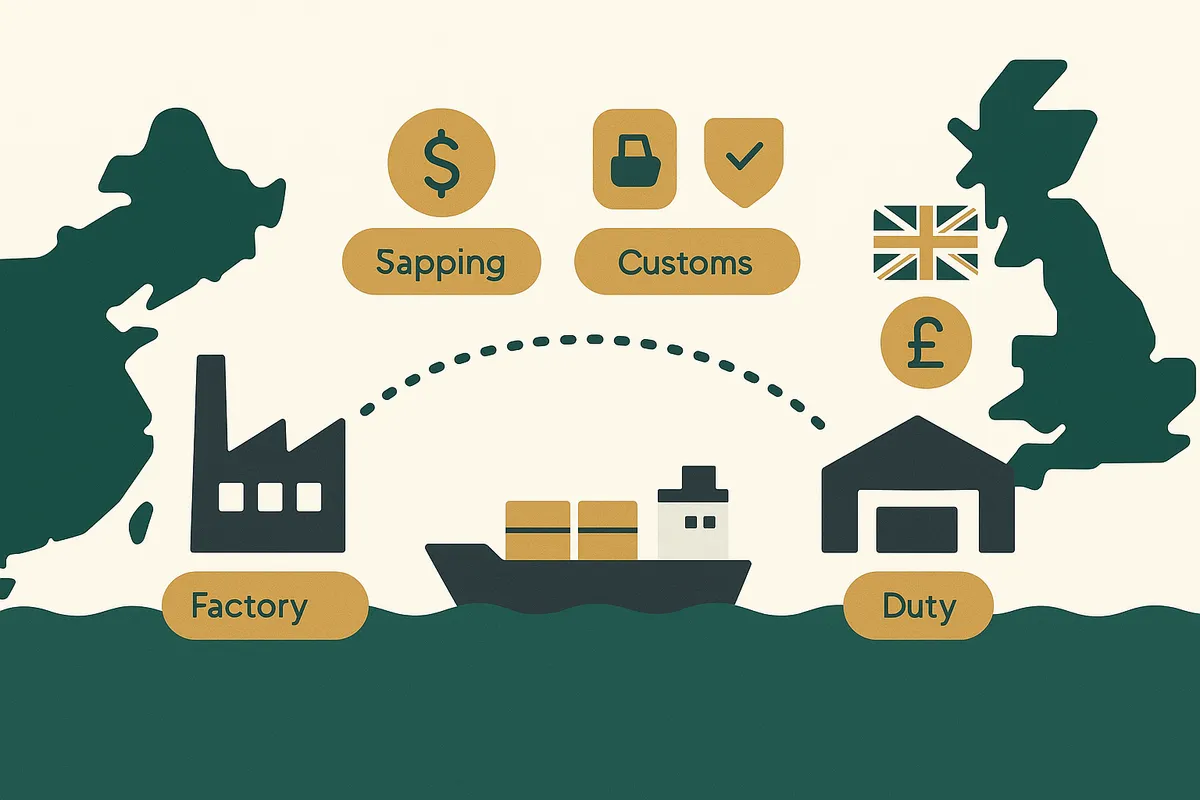
Landed Cost Calculator for UK Importers: The Complete Formula with Real Examples
Most UK importers underestimate their true landed cost by 15-25%. Learn the full landed cost formula, see a worked example with real China import numbers, and avoid the HMRC mistakes that trigger underpayment penalties.
Safety Stock Formula for Ecommerce: The Calculation That Prevents Stockouts
The safety stock formula is Z x σd x √LT — but what does that actually mean? A plain-English breakdown with worked examples for ecommerce brands, including how to calculate safety stock when your lead time is 190 days.

Weeks Cover in Stock Management: Formula, Examples & How to Use It
Weeks cover tells you how many weeks your current stock will last at the current sales rate. Learn the formula, what good weeks cover looks like, and how to calculate it for thousands of SKUs.
Get early access to Canopy
The inventory system built for Shopify brands. No spam — just a heads-up when we launch.