Landed Cost Calculator: The Full Formula UK Importers Actually Need
By Canopy Team
Quick answer
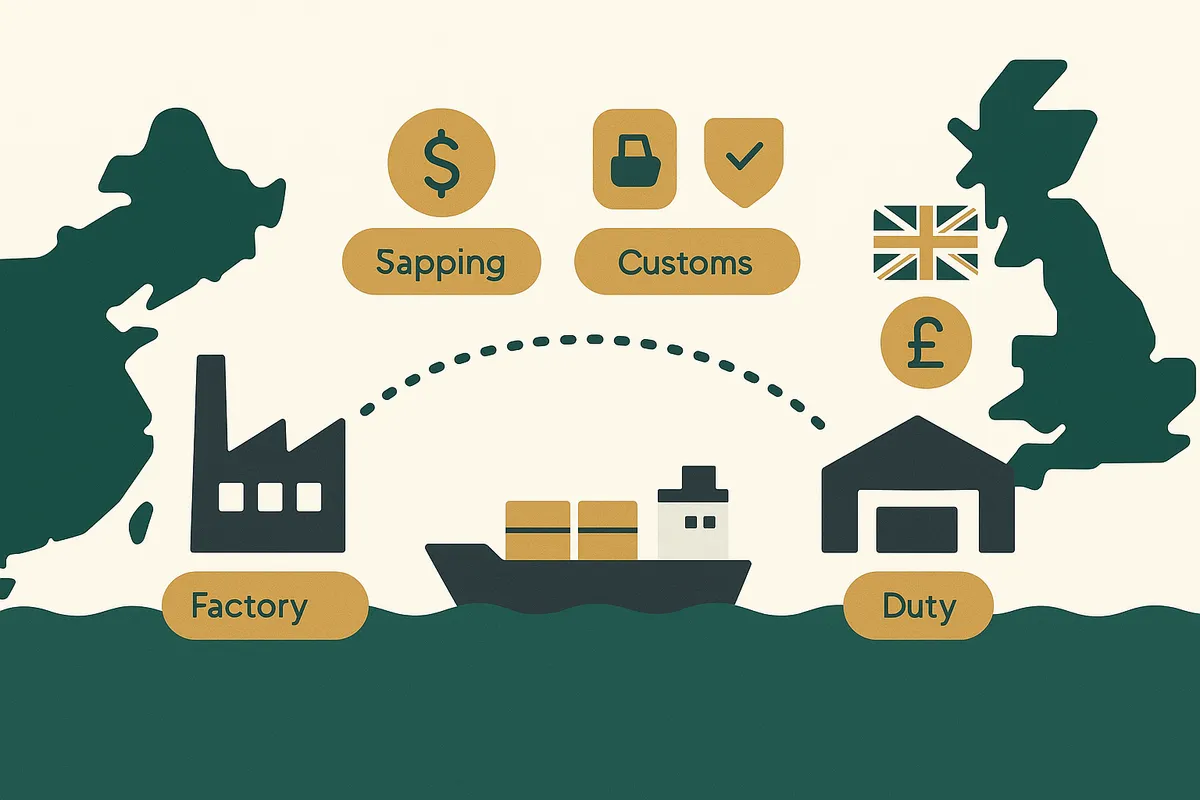
Landed cost is the total cost of getting a product from your supplier's factory to your warehouse shelf, ready to sell. It includes the unit price, packaging, branding (logos, labels), freight shipping, customs duty, VAT, insurance, and currency conversion costs. Most UK importers get landed cost wrong because they only account for the unit price and shipping — missing 15-25% of the true cost. The full formula is: Landed Cost = Unit Price + Packaging + Branding + Allocated Freight + Customs Duty + Import VAT + Insurance + FX Spread. Getting this wrong means your profit margins are lower than you think, your pricing is too low, and your stock valuation reported to HMRC is inaccurate.
What landed cost actually means (and why most people get it wrong)
Landed cost is not your supplier invoice amount. It is not the number on the proforma invoice plus a rough guess at shipping. Landed cost is every single cost incurred from the moment a product is manufactured to the moment it sits on your warehouse shelf ready to be picked, packed, and shipped to a customer.
The reason most UK importers get this wrong is simple: the costs arrive at different times, from different sources, in different currencies. Your supplier invoices in CNY or USD. Your freight forwarder bills in GBP. HMRC collects duty and VAT at the port. Your bank takes an FX spread you never see itemised. Your warehouse charges for receiving and putting away the delivery.
When these costs arrive weeks apart from different companies, most merchants never aggregate them back to a per-unit level. They know roughly what a shipment cost but they couldn't tell you the precise landed cost of a single unit of any given SKU. This is a problem because your pricing, your margin calculations, and your stock valuation all depend on this number being accurate.

The full landed cost formula explained
Here is the complete landed cost formula broken down into each component. Every element needs to be calculated at the per-unit level.
1. Unit price — the price your supplier charges per unit, in their currency. This is your FOB (Free on Board) or EXW (Ex Works) price depending on your Incoterms agreement. FOB means the supplier covers costs to the port of departure. EXW means you pay everything from the factory gate.
2. Packaging cost — custom packaging (branded boxes, poly bags, tissue paper, hang tags) charged per unit by your supplier or a separate packaging vendor. This is often quoted separately from the unit price.
3. Branding/logo cost — screen printing, embroidery, heat transfer, or other branding applied to the product. Some suppliers include this in the unit price, others itemise it. Always confirm which.
4. Allocated freight cost — total shipping cost (sea freight, haulage to port, UK drayage from port to warehouse) divided across all units in the shipment. You need to allocate by volume or weight depending on your freight terms. A CBM-based allocation is most common for sea freight.
5. Customs duty — charged as a percentage of the customs value (usually CIF — Cost, Insurance, Freight). The duty rate depends on the commodity code (HS code) of your product. UK duty rates for most consumer goods from China range from 0% to 12%. Check the UK Global Tariff on gov.uk for your specific codes.
6. Import VAT — 20% charged on (customs value + duty). This is reclaimable if you're VAT registered, but it's still a cash flow cost that affects your working capital.
7. Insurance — marine cargo insurance, typically 0.3-0.5% of the shipment value. Some merchants skip this. Don't — a single lost container can bankrupt a small brand.
8. FX spread — the difference between the mid-market exchange rate and the rate your bank actually gives you. UK banks typically charge a 1-3% spread on GBP/CNY conversions. This is hidden profit for the bank and a real cost for you.

Worked example: Bailey & Coco dog harness from China
Bailey & Coco imports dog harnesses from a manufacturer in Guangdong, China. Let's calculate the full landed cost for one unit of their best-selling harness.
Starting numbers: - Unit price (FOB Shenzhen): ¥22.50 CNY - Packaging (branded box + poly bag): ¥2.70 CNY (£0.30) - Logo heat transfer: ¥0.90 CNY (£0.10) - Order quantity: 500 units - GBP/CNY exchange rate: 9.00 (mid-market) - Bank FX spread: 2.0%
Step 1: Convert unit price to GBP Unit price: ¥22.50 / 9.00 = £2.50 But the bank charges 2% spread, so effective rate is 8.82 Actual unit price: ¥22.50 / 8.82 = £2.55
Step 2: Add packaging and branding Packaging: £0.30 (adjusted for FX: £0.31) Logo: £0.10 (adjusted for FX: £0.10) Subtotal per unit: £2.96
Step 3: Allocate freight Total sea freight (Shenzhen to Felixstowe, shared container): £1,850 UK haulage (port to warehouse): £380 Total freight: £2,230 Allocated per unit: £2,230 / 500 = £4.46 Running total: £7.42
Step 4: Calculate customs duty HS code for dog harnesses: 4201.00 (saddlery and harness for animals) UK duty rate: 2.7% Customs value (CIF): £7.42 per unit Duty per unit: £7.42 × 2.7% = £0.20 Running total: £7.62
Step 5: Import VAT VAT: (£7.42 + £0.20) × 20% = £1.52 Note: reclaimable if VAT registered, but a cash flow cost Running total (ex-VAT for margin calculation): £7.62 Total including VAT (for cash flow): £9.14
Step 6: Insurance Marine insurance: 0.4% of shipment value Per unit: £7.42 × 0.4% = £0.03
Final landed cost: £7.65 per unit (ex-VAT)
Bailey & Coco sells this harness for £28.00 retail. At first glance with just the £2.50 unit price, the margin looks incredible — 91%. The actual margin after landed cost is (£28.00 - £7.65) / £28.00 = 72.7%. Still healthy, but a completely different number for financial planning. And that's before picking, packing, Shopify fees, and marketing spend.
Track your real landed cost per SKU
Canopy gives Shopify brands the inventory clarity they need to grow.
Common landed cost mistakes UK importers make
After working with dozens of UK importers, the same mistakes appear repeatedly.
Mistake 1: Using the mid-market FX rate. Your bank does not give you the mid-market rate. Ever. The spread on GBP/CNY is typically 1.5-3%, which on a £50,000 shipment is £750-1,500 of hidden cost. Use the actual rate from your bank statement or payment confirmation, not the rate you see on Google.
Mistake 2: Flat-rate freight allocation. If you ship products of different sizes in the same container, allocating freight equally per unit is wrong. A dog bed takes up 10x the space of a collar. Allocate by CBM (cubic metre) or weight, depending on which determines your freight rate.
Mistake 3: Forgetting port and handling charges. Beyond the headline sea freight rate, there are terminal handling charges (THC), customs clearance agent fees, container demurrage (if you're slow to collect), and UK delivery from port to warehouse. These typically add £400-800 per container.
Mistake 4: Wrong HS codes. Using an incorrect commodity code means you pay the wrong duty rate. Worse, HMRC can retrospectively audit your imports and apply penalties plus interest on underpaid duty. For Bailey & Coco, a dog collar could be classified under several codes — the correct one depends on the material (leather vs textile) and construction method.
Mistake 5: Not updating landed cost when rates change. Your landed cost from January is not your landed cost in June. FX rates move, shipping rates are volatile (container rates tripled during 2021-2022 and have since normalised), and duty rates change with trade policy. Recalculate landed cost with every new shipment.
HMRC compliance: why your landed cost matters beyond pricing
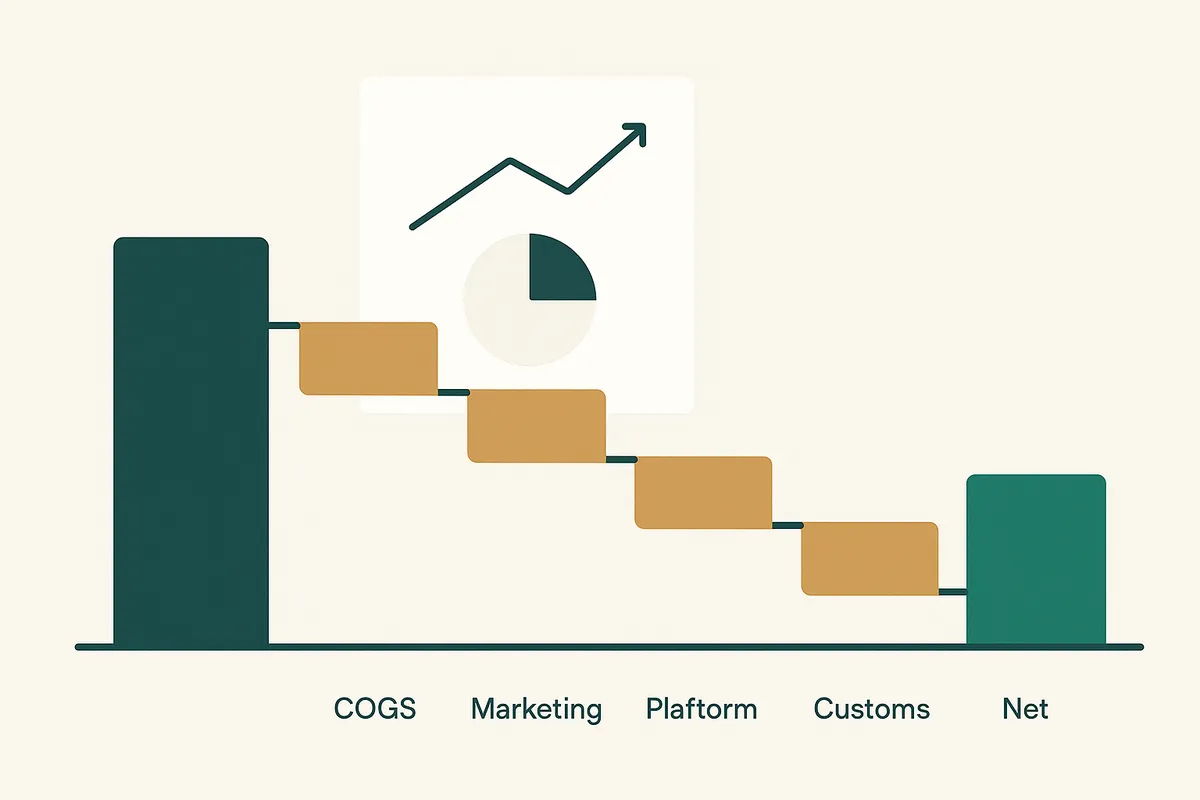
Your landed cost isn't just a business metric — it's a compliance requirement. HMRC requires that your import declarations accurately state the customs value of goods. This customs value is the basis for duty and VAT calculations.
If you systematically understate your customs value (even accidentally), HMRC can issue retrospective assessments going back 3 years, plus penalties of up to 100% of the unpaid duty in cases of deliberate undervaluation.
Common compliance issues include: - Declaring only FOB value when you should be declaring CIF (Cost, Insurance, Freight) - Not including royalties or licence fees in the customs value (if your supplier charges separately for pattern licences, this may need to be included) - Transfer pricing issues if you're importing from a related company - Failing to declare assists — if you provide your supplier with moulds, tools, or designs, their value may need to be added to the customs value
For most small Shopify brands importing from China, the biggest risk is simply using the wrong HS code and paying incorrect duty rates. Get a customs broker to review your top 20 products' classifications annually.
How to track landed cost per SKU in your inventory system
The goal is to have an accurate, up-to-date landed cost for every SKU in your system. This becomes your cost of goods sold (COGS) figure and the basis for all margin calculations.
Here's the workflow Bailey & Coco uses:
1. Purchase order stage — when creating a PO, record the supplier unit price, packaging cost, and branding cost per SKU. Use the estimated FX rate at the time of payment.
2. Shipment booking — when freight is confirmed, allocate the total shipping cost across all SKUs in the shipment by CBM. Add insurance cost.
3. Customs clearance — once the goods clear customs, record the actual duty paid and the exact customs value declared. Update the FX rate to the actual payment rate.
4. Goods received — when stock arrives at the warehouse, finalise the landed cost per unit by adding any last-mile delivery or handling charges.
5. Update your inventory system — the final landed cost per unit becomes your new COGS for that batch. If you're using weighted average costing, blend it with existing stock.
This sounds like a lot of work. It is — if you do it manually in spreadsheets. An inventory system that links purchase orders to shipments to goods receipts can automate most of this. That's exactly what Canopy is built to do.
Tools for calculating and tracking landed cost
If you're calculating landed cost manually, a well-structured spreadsheet can work for small operations. You need columns for every cost component, formulas that allocate shared costs (freight, insurance) across units, and a process for updating FX rates with actuals.
For growing brands, manual tracking breaks down quickly. With 500+ SKUs arriving in mixed containers multiple times per year, spreadsheet errors compound. The tools worth considering:
Canopy — built specifically for Shopify brands importing from overseas. Links purchase orders to shipments, automatically allocates freight by CBM, tracks duty rates per HS code, and calculates landed cost per unit on goods receipt. The profit margin calculator gives you real-time margin visibility based on actual landed cost, not estimates.
Inventory Planner — has a cost tracking feature but doesn't handle the customs/duty calculation natively. You'd need to input your final landed cost manually.
A good customs broker — your broker should provide a landed cost breakdown with every clearance. If they don't, switch brokers. Companies like ClearFreight and Bansard provide detailed cost breakdowns as standard.
XE or Wise for FX tracking — track actual payment rates (not mid-market) so you can use real numbers in your calculations.
Stop guessing your margins
Canopy gives Shopify brands the inventory clarity they need to grow.
Frequently Asked Questions
Landed cost is the total cost of getting a product from your supplier to your warehouse shelf. It includes the unit price, packaging, branding, shipping, customs duty, import VAT, insurance, and any currency conversion costs. It is the true cost of your inventory.
Add together: unit price (converted to GBP at actual bank rate, not mid-market), packaging cost, branding cost, allocated freight (sea shipping + UK haulage divided by units), customs duty (duty rate x CIF value), insurance (typically 0.3-0.5% of shipment value), and any handling fees. Import VAT at 20% is added on top but is reclaimable if VAT registered.
Duty rates vary by product type and are determined by the HS (Harmonized System) commodity code. Most consumer goods from China attract duty rates between 0% and 12%. Check the UK Global Tariff tool on gov.uk using your specific HS code. Common examples: textile accessories 6.5-12%, leather goods 1.7-5%, plastic items 0-6.5%.
It depends on the purpose. For margin calculations, use the ex-VAT landed cost because you reclaim import VAT if you are VAT registered. For cash flow planning, include the 20% import VAT because it represents real money you pay upfront and only reclaim on your next VAT return — typically 1-3 months later.
FOB (Free on Board) means the supplier covers costs to the port of departure — you pay freight from there. CIF (Cost, Insurance, Freight) means the supplier covers costs to the UK port including shipping and insurance. Your Incoterms agreement determines your starting point. Most UK SME importers from China use FOB and arrange their own freight.
Recalculate with every new shipment. FX rates, shipping costs, and duty rates change constantly. A landed cost calculated in January may be 10-20% different by June due to rate fluctuations alone. Using outdated landed costs means your margin calculations and pricing decisions are based on wrong data.
Related pages
Related Articles
Importing from China: The Stock Management Guide for UK Ecommerce Brands
The 190-day lead time problem is real. Learn how to manage stock when you source from China — ordering calendars, MOQ strategy, Chinese New Year planning, and packing list verification with real examples from a brand managing 152 patterns.

Dead Stock in Ecommerce: How to Identify, Calculate Cost & Eliminate It
Dead stock costs the average Shopify merchant 20-30% of their inventory value. Learn how to identify dead stock, calculate the true carrying cost, and build clearance strategies that recover cash.

Weeks Cover in Stock Management: Formula, Examples & How to Use It
Weeks cover tells you how many weeks your current stock will last at the current sales rate. Learn the formula, what good weeks cover looks like, and how to calculate it for thousands of SKUs.
Get early access to Canopy
The inventory system built for Shopify brands. No spam — just a heads-up when we launch.