Shopify Inventory Management: The 2026 Guide for Growing Brands
By Andrew Simpson
Quick answer
Shopify's built-in inventory management handles the basics: tracking stock quantities across locations, adjusting inventory on receipt, and syncing levels across sales channels. But it lacks purchase order management, demand forecasting, supplier lead time tracking, weeks cover calculations, and dead stock identification. For stores under 200 SKUs selling through a single channel, Shopify native is often enough. Above that, you need a dedicated inventory app. The best options in 2026 are Canopy (for weeks cover and reorder intelligence), Inventory Planner (for demand forecasting), and Prediko (for DTC brands wanting a clean interface).
What Shopify's native inventory can actually do
Shopify has steadily improved its inventory features over the past few years. As of 2026, the native Shopify admin provides:
Multi-location inventory tracking — assign stock quantities to different warehouses, retail locations, or fulfilment centres. Shopify automatically allocates orders to the nearest location with stock.
Inventory adjustments and transfers — manually adjust stock levels (received stock, damaged goods, corrections) and create transfers between locations. Each adjustment is logged with a reason code.
Low stock alerts — set a threshold per product and receive an email when stock drops below it. Basic but functional.
Inventory reports — the Analytics section includes inventory-specific reports: snapshot of inventory levels, ABC analysis by variant, average inventory sold per day, and sell-through rate.
Shopify Flow automation — trigger workflows based on inventory events, like automatically hiding a product when stock hits zero or notifying a supplier when stock drops below a threshold.
These features work well for the fundamentals. If you have a small catalogue with domestic suppliers and straightforward ordering, you can genuinely run your inventory through Shopify admin alone. The problems emerge when you scale.
Why Shopify's native inventory breaks down at scale
Shopify's inventory system was designed for simplicity, and simplicity comes at the cost of depth. Here are the specific gaps that cause problems as you grow:
No purchase order management. Shopify has no way to create, send, or track purchase orders. You can't record what you've ordered from suppliers, match received quantities against expected quantities, or track PO status. With Stocky being retired (August 2026), there's no free Shopify-native solution for this.
No demand forecasting. Shopify shows you what sold in the past but makes no predictions about future demand. There's no seasonal modelling, no trend detection, and no suggested reorder quantities.
No weeks cover or forward-looking metrics. The inventory reports show current levels and historical sell-through, but don't answer the crucial question: "How long will this stock last?" You have to calculate weeks cover manually.
No supplier lead time integration. Shopify doesn't store supplier information at the product level. There's no way to record that Supplier A has a 2-week lead time while Supplier B has a 27-week lead time, and there's no system to factor these differences into reorder timing.
Flat low-stock alerts. The low stock threshold is a single number per product. It doesn't adjust based on sales velocity or lead time. Setting a threshold of "10 units" means something completely different for a SKU selling 50/week versus one selling 1/week.
No dead stock identification. Shopify won't proactively flag products that haven't sold in months. You have to manually analyse inventory reports to find them.

Real-world impact: what these gaps cost Bailey & Coco
Bailey & Coco's experience illustrates every one of these gaps. With 2,845 SKUs, 152 patterns, and a supply chain that stretches from China to the UK, Shopify's native inventory was wildly insufficient.
Without purchase orders in Shopify, they tracked POs in a separate Google Sheet. This meant stock receiving was a two-system process: update the spreadsheet, then manually adjust quantities in Shopify. Double entry meant double the chance of errors. Their inventory accuracy on a quarterly stocktake was running at 91% — meaning 9% of their stock quantities were wrong at any given time.
Without demand forecasting, their founder made purchasing decisions based on last quarter's sales, a spreadsheet of "bestsellers by gut feel," and whatever the supplier recommended as minimum order quantities. The result was chronic over-ordering of slow patterns and chronic under-ordering of fast ones.
Without weeks cover visibility, they didn't know which of their 2,845 SKUs were 3 weeks from stocking out until someone physically noticed empty shelves. With a 27-week lead time, discovering a stockout issue late meant a 6-month gap in availability for that SKU.
The estimated annual cost of these gaps — combining lost sales from stockouts, carrying cost of dead stock, and labour time spent on manual workarounds — was approximately £65,000. That's not unusual for a brand at Bailey & Coco's scale. It's just usually invisible because no one calculates it.
Fill the gaps Shopify leaves in your inventory
Canopy gives Shopify brands the inventory clarity they need to grow.
How to build a proper inventory system on Shopify
You don't need to leave Shopify to get proper inventory management. You need to layer the right tools on top of it. Here's how to think about building your inventory stack:
- Keep Shopify as your source of truth for stock levels — Shopify should remain the system that tracks "how much of each SKU is in each location right now." It's reliable for this, and your sales channels (online store, POS, wholesale) all sync to it.
- Add a dedicated app for purchase orders and receiving — this is the most critical gap to fill. You need a system that lets you create POs, send them to suppliers, and receive stock against them with discrepancy checking.
- Layer in demand-aware reorder suggestions — the app should calculate weeks cover, compare it against supplier lead times, and tell you what to reorder and when. Not just "stock is low" but "you need to order 450 units of Navy Collar M from Supplier A by Friday to avoid a stockout."
- Set up dead stock monitoring — configure alerts for SKUs that cross your dead stock thresholds (e.g., 52+ weeks cover or zero sales in 90 days). Review these monthly and act on them.
- Implement barcode scanning for receiving — reduce inventory recording errors by scanning products during receiving rather than manually entering quantities.
- Run quarterly stocktakes — even with perfect systems, physical stock drifts from system stock due to theft, damage, and miscounts. Quarterly stocktakes catch the drift before it compounds into serious discrepancies.
Best Shopify inventory management apps in 2026
With Stocky shutting down, the Shopify inventory app landscape is consolidating around a few serious players. Here's an honest assessment of each:
Inventory Planner — The most mature option. Excellent demand forecasting with seasonal adjustments. Strong for brands that need sophisticated replenishment algorithms. The downsides are complexity (steep learning curve, interface assumes inventory management expertise) and price (£100-300+/month depending on SKU count). Best for brands with a dedicated inventory manager on staff.
Prediko — The design-forward option. Clean interface, easy to learn, good for DTC brands that want demand planning without the spreadsheet-level complexity of Inventory Planner. Less suited to complex supply chains with multiple suppliers and long lead times. Pricing is comparable to Inventory Planner.
Katana — More of a manufacturing/production tool than pure inventory management. Excellent if you make your own products and need bill of materials tracking. Overkill for brands that simply buy and resell finished goods.
Canopy (in development, accepting waitlist) — Being built specifically to address the Stocky gap with a focus on weeks cover, supplier lead time modelling, and purchase order management. Designed for founders and ops managers rather than inventory specialists. Pricing is planned to be significantly lower than the alternatives, starting from £49/month. The trade-off is that it's not yet available — but for brands that don't need to migrate immediately, it's worth watching.
The right choice depends on your specific situation. If you need a tool today and have budget, Inventory Planner is the safe choice. If you can wait and want something purpose-built for the gaps Shopify leaves, Canopy is being designed exactly for that.

The metrics that actually matter
Whatever tool you choose, make sure it gives you visibility into these five metrics at the variant level:
Weeks cover — How long will current stock last? This is your early warning system for stockouts and overstocking.
Sell-through rate — What percentage of your starting inventory sold in a period? Anything below 40% sell-through in a season is a problem.
Reorder point — The stock level at which you need to place a purchase order, factoring in lead time and demand variability.
Days of supply — Similar to weeks cover but useful for faster-moving products where weekly granularity is too coarse.
Inventory accuracy — The percentage match between your system stock and physical stock at the last stocktake. Below 95% accuracy means your entire inventory picture is unreliable.
These five metrics, tracked consistently at the variant level, will prevent the vast majority of inventory problems. Most Shopify merchants operate without any of them. That's not a criticism — it's an opportunity. The brands that implement proper inventory metrics gain a significant competitive advantage in capital efficiency and customer satisfaction.

Frequently Asked Questions
Yes, Shopify includes basic inventory management: multi-location stock tracking, inventory adjustments, transfers, low stock alerts, and inventory reports. However, it lacks purchase orders, demand forecasting, weeks cover tracking, and supplier management.
The best choice depends on your needs. Inventory Planner is the most mature option for demand forecasting. Prediko is more design-forward and easier to learn. Canopy (in development) focuses on weeks cover and is designed for brands migrating from Stocky. Katana is best for manufacturers.
For stores with under 200 SKUs, a single supplier, and domestic lead times, Shopify admin can be sufficient. Above that, the lack of purchase orders, demand forecasting, and forward-looking metrics like weeks cover creates blind spots that cost money.
Shopify's built-in inventory features are included in all plans. Third-party apps range from £49/month (Canopy, planned pricing) to £300+/month (Inventory Planner for large catalogues). The right app typically saves 5-10x its cost in prevented stockouts and reduced dead stock.
Stocky will be completely removed from all Shopify stores on 31 August 2026. Purchase orders, supplier data, and demand forecasting inside Stocky will become inaccessible. You need to export data and migrate to a replacement app before the deadline.
Shopify natively supports multi-location inventory. Go to Settings > Locations to add warehouses, retail stores, or fulfilment centres. Assign stock quantities per variant per location. Shopify automatically routes orders to the nearest location with available stock.
Related pages
Related Articles
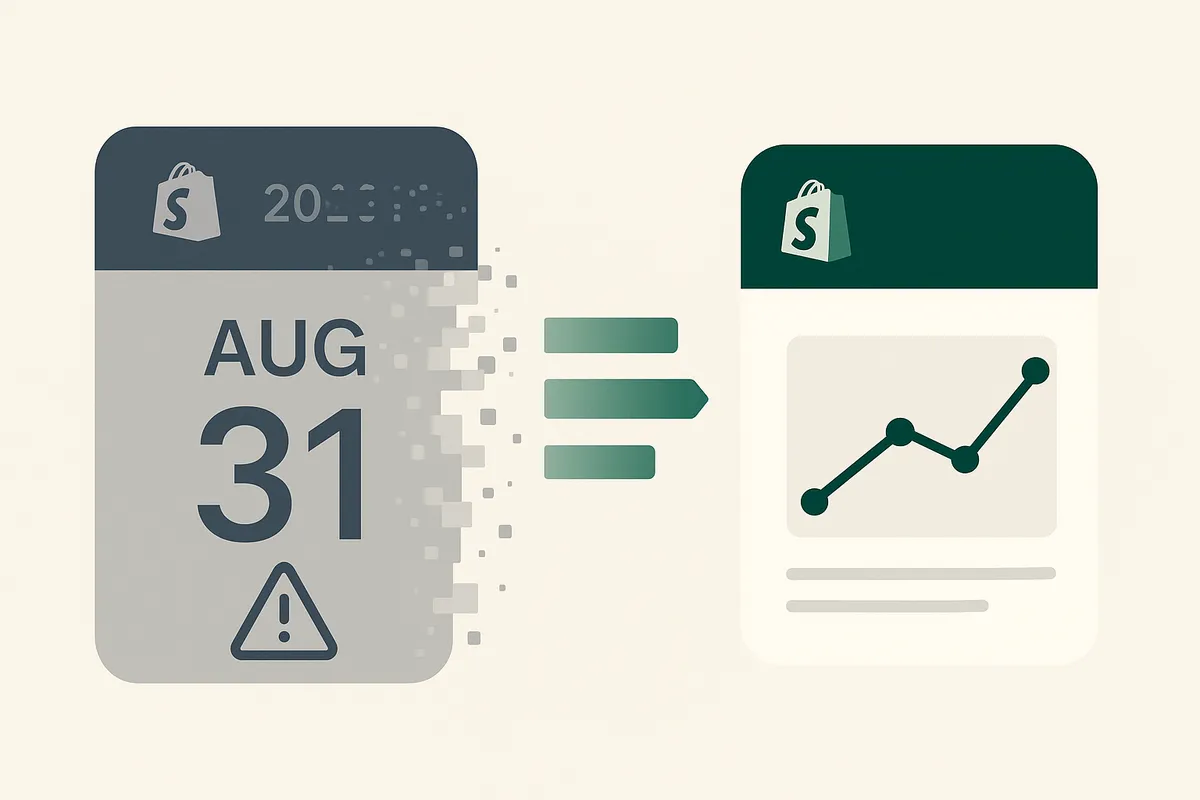
Stocky App Shutting Down: What Shopify Merchants Need to Do Before August 2026
Shopify's Stocky app is shutting down on 31 August 2026. Here's what happens to your purchase orders, demand forecasting, and stock reports — and the best Stocky replacements to migrate to.
Weeks Cover in Stock Management: Formula, Examples & How to Use It
Weeks cover tells you how many weeks your current stock will last at the current sales rate. Learn the formula, what good weeks cover looks like, and how to calculate it for thousands of SKUs.
Barcode Scanning for Shopify: The Complete Setup Guide for 2026
Learn how to set up barcode scanning for your Shopify store. Covers phone-based scanning, hardware scanners, receiving stock, and picking orders — with real ROI calculations.
Get early access to Canopy
The inventory system built for Shopify brands. No spam — just a heads-up when we launch.