Inventory Management for Pet Products: What Makes This Industry Different
By Canopy Team

Quick answer
Pet product ecommerce has unique inventory management challenges: extreme size variant proliferation (XS to XXL across every pattern), matching set requirements (collar and lead in the same pattern must both be in stock for bundles), seasonal demand spikes (Christmas, summer outdoor season), and perishable items (treats, supplements with expiry dates). The UK pet industry is worth £8 billion annually with ecommerce growing 12% year-on-year. Success requires managing these complexities without overcomplicating your operations. Bailey & Coco, a dog accessories brand with 2,845 SKUs, provides a case study in how to get it right.
Why pet products are uniquely complex for inventory management
Pet products sit at the intersection of several inventory management challenges that most other product categories face individually but pet brands face simultaneously. Fashion-level variant complexity (sizes, colours, patterns) combined with food-industry concerns (expiry dates, batch tracking) combined with gift-market seasonality (Christmas and Valentine's spikes) combined with accessory-market bundle expectations (matching sets). A fashion brand deals with size variants but not expiry dates. A food brand deals with perishables but not matching pattern sets. A pet accessories brand deals with all of it at once. This is why generic inventory management advice often falls short for pet ecommerce. The strategies that work for a t-shirt brand or a supplement brand need to be adapted for the specific challenges of the pet industry.

Challenge 1: size variant proliferation
A single dog collar design needs to exist in at least 5 sizes (XS, S, M, L, XL) to cover the market from Chihuahuas to Great Danes. Add a matching lead (usually 2-3 lengths), a harness (5 sizes), a bandana (3 sizes), and a poop bag holder (one size), and a single pattern generates 16-19 SKUs.
Bailey & Coco has 152 active patterns. At an average of 18.7 SKUs per pattern, that produces 2,845 individual SKUs to manage. Every size within a pattern has different sales velocity — Medium dog collars outsell XS by roughly 4:1 in most breeds. But the XS collar exists in the same pattern and must be stocked because customers searching for that pattern expect size availability.
The inventory management challenge: you cannot order the same quantity of each size. You need to model demand by size and order accordingly. This is where most generic inventory tools fail — they treat each SKU independently without understanding the size-curve relationship within a pattern.
Challenge 2: matching sets and bundle coordination
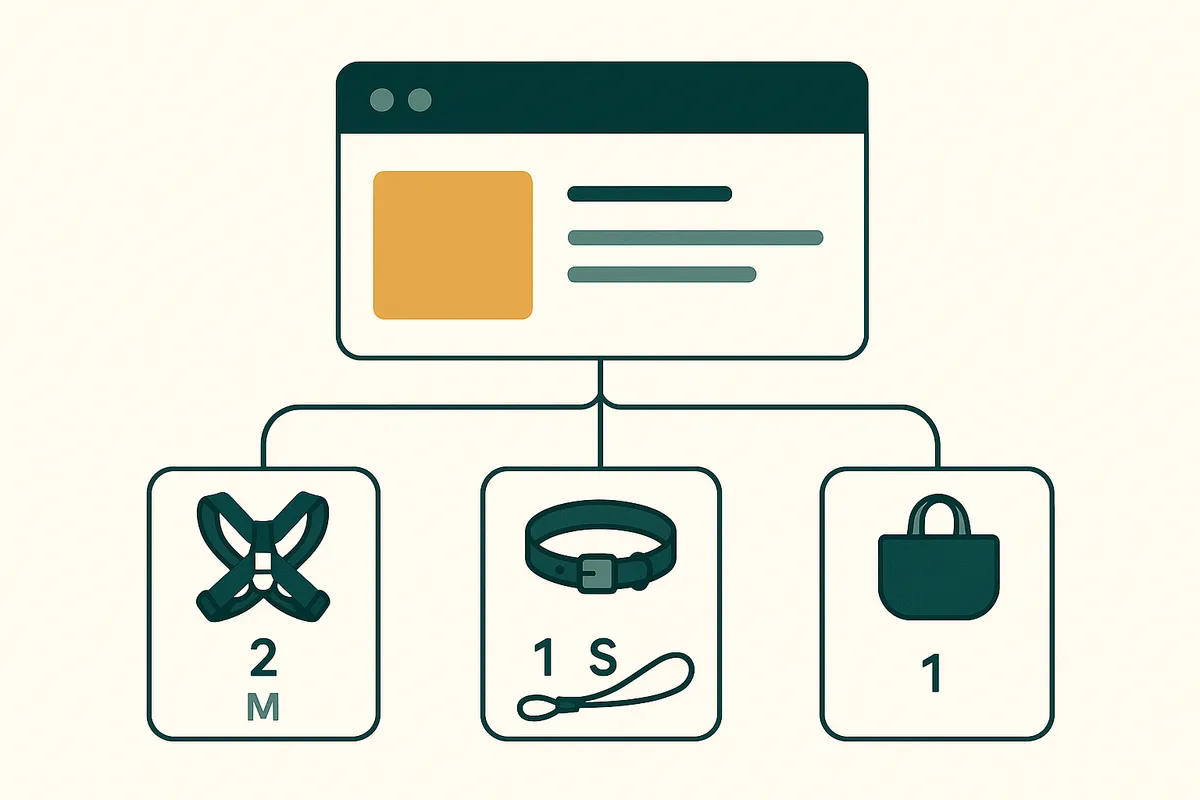
Pet owners want matching accessories. A customer buying a floral collar wants the matching lead, harness, and bandana in the same pattern. This creates bundle dependency — a stockout on the Medium lead in a pattern effectively makes the entire Medium bundle for that pattern unavailable, even if you have plenty of collars and bandanas.
The compounding effect is significant. Bailey & Coco's data shows that 42% of customers who buy a collar also add the matching lead, and 23% buy a three-piece bundle. When any component in a popular pattern goes out of stock, bundle revenue drops by 60-80% for that pattern even though most components are available.
Proper inventory management means monitoring weeks cover at the component level within each pattern and reordering the components that will run out first — not the ones with the lowest absolute stock quantity.
Challenge 3: seasonal demand patterns
The pet accessories market has distinct seasonal patterns that affect inventory planning:
January-February: Post-Christmas slump. Sales drop 30-40%. This is when dead stock from Christmas over-ordering becomes visible.
March-April: Spring refresh. Customers buy new accessories as weather improves. Floral and bright patterns spike.
May-August: Summer peak for outdoor accessories — cooling bandanas, reflective leads for evening walks, travel accessories for holidays.
September-October: Autumn transition. Halloween-themed products have a narrow 4-week selling window.
November-December: Christmas gift season. The biggest sales period — 40-60% above average monthly revenue. Christmas-themed products and gift sets drive volume.
For brands importing from China with 190-day lead times, Christmas stock needs to be ordered in May. Spring stock needs to be ordered in September the previous year. Getting seasonal quantities wrong means either massive dead stock or missed sales during peak periods. Bailey & Coco's approach: they analyse year-on-year seasonal data and adjust purchase quantities by pattern based on historical performance, adding a 15% buffer for their evergreen patterns and being conservative (actual quantities minus 10%) on trend-driven seasonal patterns.
Challenge 4: perishable product management
Many pet ecommerce brands sell treats, supplements, food toppers, or grooming products with expiry dates. This adds a dimension that accessories brands do not face: the stock you hold can become unsellable even without a demand problem.
Batch tracking and FIFO (First In, First Out) are essential for perishable pet products. Every incoming delivery must be logged with its batch number and expiry date. When picking orders, the oldest batch must ship first. Products within 90 days of expiry should be flagged for clearance or promotional use.
Shopify does not natively support batch tracking or expiry date management. Merchants selling perishable pet products need either meticulous spreadsheet tracking or an inventory management system with batch and expiry functionality.

How Bailey & Coco manages 2,845 SKUs across 152 patterns
Bailey & Coco's inventory management workflow is built around weekly reviews of weeks cover by pattern, not individual SKUs. Instead of looking at 2,845 individual products, they group by pattern (152 patterns) and look at the lowest-cover component within each pattern.
If the Vintage Floral pattern shows: collar (12 weeks cover), lead (6 weeks cover), harness (18 weeks cover), bandana (22 weeks cover) — they know the lead is the urgent reorder. Left unchecked, the lead stockout will also kill bundle sales for the entire pattern in 6 weeks.
Their weekly review takes approximately 30 minutes using colour-coded weeks cover data. Red patterns (any component below 8 weeks) get immediate purchase order action. Amber patterns (8-15 weeks) go on the monitoring list. Green patterns (15+ weeks) are healthy. This pattern-level approach reduces 2,845 decisions to 152 decisions — manageable for a small team reviewing weekly.
Manage pet product inventory without the complexity
Canopy gives Shopify brands the inventory clarity they need to grow.
Pet industry inventory benchmarks
Based on data from UK pet ecommerce brands, here are typical inventory benchmarks:
Average SKU count for a pet accessories brand: 200-3,000 SKUs. Inventory turnover rate: 4-6 times per year (healthy), 2-3 times (needs improvement). Dead stock percentage: 8-15% of total inventory value (industry average), under 5% (best practice). Stockout rate: 3-5% of SKUs at any time (average), under 1% (best practice). Average order value: £25-45 for accessories, £15-30 for consumables. Return rate: 5-10% (lower than fashion due to fewer fit issues).
If your numbers deviate significantly from these benchmarks, it signals either an inventory management problem or a product-market fit issue worth investigating.

Frequently Asked Questions
Size variant proliferation (5+ sizes per product per pattern), matching set coordination (collar, lead, harness must all be in stock for bundles), seasonal demand patterns (Christmas is 40-60% above average), and perishable product management (treats and supplements with expiry dates).
A mid-size pet accessories brand typically manages 200-3,000 SKUs. The number is driven by pattern count (each pattern generates 15-20 SKUs across product types and sizes). Bailey & Coco manages 2,845 SKUs across 152 patterns.
For brands importing from China with 190-day lead times, Christmas stock needs to be ordered in May at the latest. For domestic suppliers with 2-4 week lead times, September-October ordering is sufficient. Always order Christmas-specific patterns conservatively — unsold seasonal stock has very limited clearance value.
Monitor weeks cover at the component level within each pattern. A matching set is only as available as its scarcest component. If you have plenty of collars but are running low on leads in a pattern, the bundle becomes unavailable. Reorder the scarcest component, not the one with the lowest absolute stock.
A healthy inventory turnover rate for pet ecommerce is 4-6 times per year. Below 3 suggests too much capital tied up in slow-moving stock. Above 8 might indicate insufficient stock levels and potential stockout risk. Accessories typically turn slower than consumables.
Related pages
Related Articles
Shopify Bundle Inventory Management: How to Track Component Stock Without Losing Your Mind
Managing bundle inventory on Shopify is complex — component tracking, MIN calculation, overselling prevention. Learn how brands with 151+ bundles handle it without spreadsheet chaos.

How to Calculate Weeks Cover for Shopify: Formula, Examples & Free Calculator
Learn how to calculate weeks cover for your Shopify store with the exact formula, worked examples using real data from a 2,845 SKU brand, and a free inventory calculator tool.

Dead Stock Clearance: 8 Strategies to Recover Cash from Unsold Shopify Inventory
Sitting on dead stock that won't sell? These 8 clearance strategies — from flash sales to B2B liquidation — help Shopify brands recover cash and free up warehouse space.
Get early access to Canopy
The inventory system built for Shopify brands. No spam — just a heads-up when we launch.